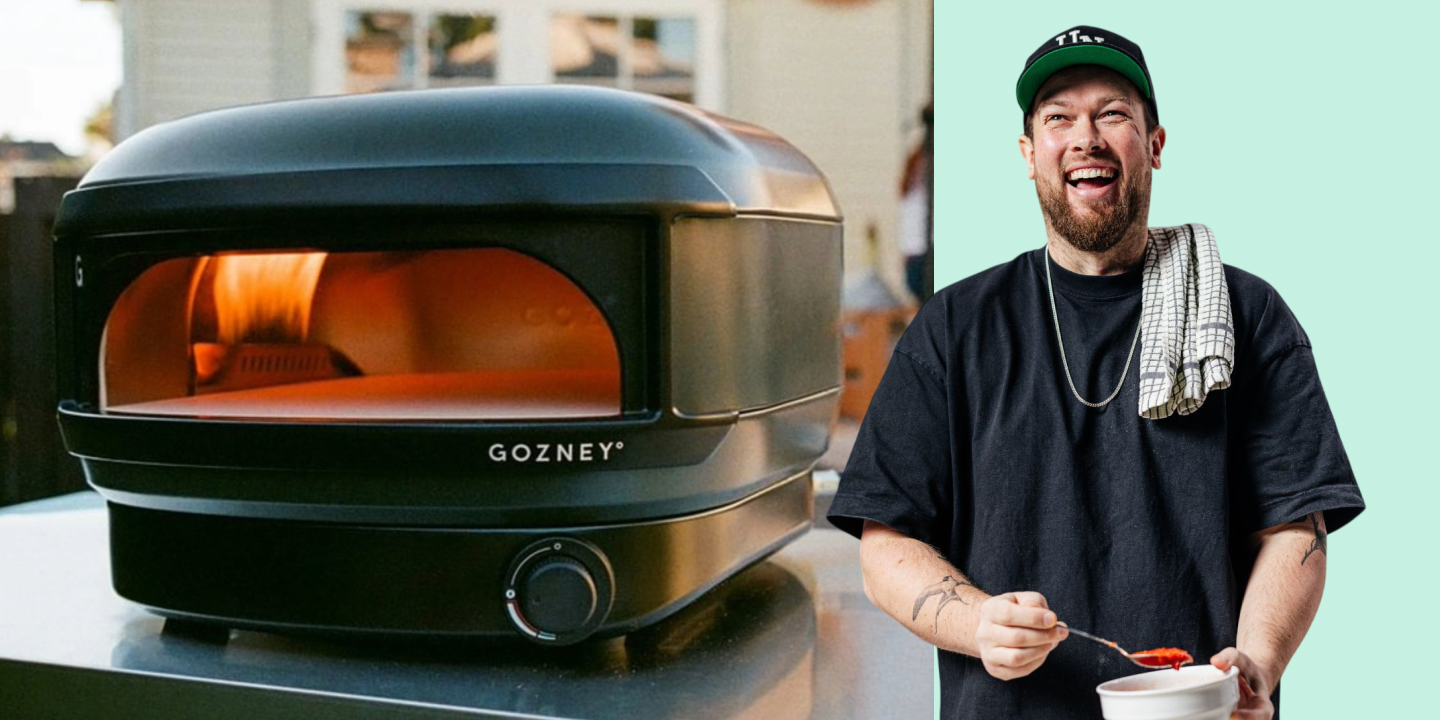
From backyard builds to $100M+ global brand: Tom Gozney on Brand, Scarcity, and the Discounting Drug
Tom Gozney built Gozney from a £5,000 loan and a homemade garden oven into a ~$100M live-fire cooking brand. In this Venice AMA he breaks down brand-building over revenue-chasing, scarcity and drop culture and distribution discipline.
Tom Gozney, Founder & Designer, Gozney · November 5, 2025 · Venice AMA
Overview
Tom Gozney built a ~$100M live-fire cooking brand starting with a £5,000 loan from his mum and an ugly brick oven in his back garden. In this Venice Founder AMA he traced the whole arc — rehab at 20, The Stone Bake Oven Company in 2011, the Roccbox, and the 2021 Gozney Dome launch that did roughly $8.5M in four hours — and reflected candidly on the lessons of scaling, having recently stepped back into the CEO seat to refocus the business on brand over pure revenue growth. His throughline: obsess over the consumer and the brand, sell the emotional why rather than the spec sheet, and let revenue follow.
Five takeaways for builders:
Sell the feeling, not the hardware. The product Gozney sells is reconnected families and social moments, not ovens. Marketing shifted from BTUs and insulation to the emotional why.
Scarcity is a growth engine — pair it with always-on. Drop culture (Supreme-style) drives cultural energy and PR; evergreen products in the background capture the demand it creates.
Discounting is a drug. It pulls demand forward and is brutal to quit. Protect premium positioning; offer upside, not markdowns.
Distribution discipline beats door count. Premium at the top of the pyramid, cascade down only as you build brand heat, and go deep regionally before going wide.
Earn the right before you spend. Don't deploy capital or add headcount until the engine is proven — align every hire and every dollar with proven performance, not hope.
From rehab to a backyard oven
Tom didn't set out to be a founder. Thrown out of school, dyslexic and ADHD, he started using drugs at 13 and nearly died at 20 before spending a year in rehab. He's nearly 19 years clean — and describes himself as still an addict at the core, who decided to get his buzz from building something exhilarating instead. Business, he says, gave him the best highs and the best lows.
"I'm gonna go and build a life for myself that is exhilarating, that's fun, and I think that's what business has given me."
— Tom Gozney, 00:11:59
The product was never the oven
Fresh out of rehab and craving community, Tom cooked pizza for friends and then built a rough brick oven in the garden. Lighting it changed the room: everyone wanted a turn building, turning, and sharing their own pizza. Within weeks friends stopped bringing beers and started bringing toppings — and Tom realized the thing worth selling wasn't the oven at all.
"The social and emotional impacts that the product actually produced was the product that I wanted to sell. It wasn't the pizza, it wasn't the oven."
— Tom Gozney, 00:15:49
The Dome: a pizza oven as a sneaker drop
For the 2021 Dome launch, Tom whiteboarded a plan with his marketing director to treat a £1,500 oven like a sneaker drop. He got ~30 culinary influencers — names like Benny Blanco and Matty Matheson, forged through relentless DM hustling — to post a single "I'm on the list" image at a synchronized global time, without saying where the list was. Anyone who signed up was auto-sent the same artwork to repost for a chance to win the first Dome off the line. It compounded into roughly 27,000 posts in 48 hours and a list of nearly 30,000 people, and the drop did around $8.5M in four hours.
Death threats as product-market fit
The launch was also a near-catastrophe. Inventory sold out while people were mid-checkout, delivery batches slipped from June to November within an hour, and the small team fielded roughly 5,000 complaints in a single hour. Tom took three death threats and was effectively canceled on Instagram — and still reads that intensity as the signal, not the failure.
"When I got my first death threat about a pizza oven, I'm like, there's something special here. We've landed on some gold here."
— Tom Gozney, 00:31:24
Getting off the discounting drug
Before the Dome, Gozney leaned on discounts, sales, and summer promos. Tom calls it an ugly drug: it pulls demand forward, leaves a hole when you stop, and pushes you to promote again. Back as CEO, he's cutting it — offering upside like a professional pizza peel with an oven rather than money off.
"We're never doing 20% off an oven again. Like, ever."
— Tom Gozney, 00:34:25
The brand triad: Supreme, Apple, Dyson
Rather than run on discounts, Tom is repositioning the brand around three references. Show up like a streetwear label with limited drops and cultural scarcity; design like Apple; and back it with credible engineering. He frames drops not primarily as revenue but as a way to drive hype, PR, and reach into new communities — then convert that attention into sales of the always-on evergreen range.
"We're gonna show up, like, supreme, like, Nike Supreme, we're gonna do limited drops, we're gonna drive, like, cultural scarcity, we're gonna design products like Apple, and we're gonna have the underpinned engineering like Dyson."
— Tom Gozney, 00:35:04
Sell the why, not the what
Tom's sharpest marketing lesson is to stop selling specs. He gave a Roccbox to the CEO of Yeti, who called six months later to say his 16-year-old daughter now brings friends over for a Thursday pizza night — and that he'd gotten his relationship with her back. Reconnected families and phones-in-a-drawer moments, Tom argues, are the actual product. In the early days he pitched 30mm of insulation and a 74,000 BTU flame; he learned that means nothing to a consumer.
"You've given me my relationship back with my daughter, and that is the magic that we sell."
— Tom Gozney, 00:42:48
Distribution discipline: the IMS pyramid
Asked how he decides what to sell where, Tom points to what he calls an IMS (Integrated Marketplace Segmentation) pyramid: premium products at the top, cascading into more mass retail only as you build brand heat — and never handing premium products to lower-end retailers. Treat the retailer like your most important customer, and make every door tell the brand story rather than just chase revenue. Gozney's US business, Tom admits, drifted from this rule — going too wide too fast and leaning on retail doors at the expense of the direct-to-consumer engine that teaches you who your consumer is. The regions that held the discipline — the UK, Europe, and Australia — are the ones performing best, and refocusing the US around it is the correction he's now leading.
To get big, act scrappy
Tom's growth philosophy runs counter to the idea that "to get big, you've got to act big" — he believes you get big by staying scrappy. He learned that asking influencers for two posts in exchange for a free product got him nothing — the unlock was to give the product freely, say he was just proud they owned it, and let them post because they wanted to. He credits that reversal with getting LeBron James to post non-stop.
"Bro, have the product. I'm so f***ing proud you own it. Please don't post."
— Tom Gozney, 00:45:09
Earn the right before you build
On how to deploy capital as the company scales, Tom's rule is not to spend a dollar until the team earns the right. He built a long-range revenue strategy as a deck, then broke it into interchangeable building blocks — "agnostic of time" — each governed by clear revenue and profitability guardrails. The company plans conservatively and only pulls a new block forward when it over-delivers, so it never takes on inventory or headcount risk chasing a number it hasn't proven.
"This is LEGO. And every building block, we have to earn the right to disseminate and build and put in place."
— Tom Gozney, 01:03:49
Q&A highlights
Q: When the Dome went viral, what did your team look like? (Jennifer Bailey)
About 25–30 people, roughly $10–15M in annual revenue, with Tom still running marketing himself. They outsold the entire prior year in four hours. There was no reserve inventory — the board hadn't believed a £1,500 product would move, and it sold ~5,000 units in the first four hours.
Q: What percentage of revenue is D2C, and how has that changed? (Luke Hersheson)
Gozney started 100% direct-to-consumer at ~$30M in sales, then moved into wholesale in 2022 and grew from $30M to ~$100M by opening retail doors — but D2C is only ~30% today. Tom's view: the business leaned too hard on doors and needs to reinvest in the D2C engine that teaches you who your consumer is.
Q: Once you've raised money, how do you decide what to spend it on? (Paul Kalo)
Don't spend until you earn the right. Prove the front-end performance connects to the back end — inventory forecasting, distribution, surgical performance marketing — before deploying capital or adding headcount. The lesson Tom drew: place bets once the data justifies them, not before.
Resources Tom referenced
Gozney — Tom's live-fire outdoor cooking brand; products include the Roccbox (2016), the Dome (2021), and the Arc.
The Stone Bake Oven Company — the commercial wood-fired oven business Tom launched in 2011 that preceded Gozney.
Allday Goods — London knife brand (recycled-plastic handles, Japanese-style blades) Tom invests in; cited as a drop-culture example.
Get Baked — Leeds cult bakery behind the "Bertha" cake; Tom's example of applying sneaker-style drop culture to cake.
Yeti — the cooler and drinkware brand whose CEO features in Tom's "sell the why" anecdote.
About Tom Gozney
Tom Gozney is the Founder & Designer of Gozney, the live-fire outdoor cooking brand he built from a £5,000 loan and a homemade garden oven into a business doing roughly $100M in annual sales. He launched The Stone Bake Oven Company in 2011, the portable Roccbox in 2016, and the direct-to-consumer Gozney Dome in 2021, and returned to the CEO role in late 2025.
Related Articles
Continue reading with these related insights and strategies.
Tom van der Kolk led Ekster's US expansion to roughly 80–85% of its revenue and is now taking The Longevity Store there. In this Venice All Hands he covers entity setup, the importance of hiring native US copywriters, and the avatar-and-CBO playbook for finding your American angle.
ZAPPLY co-founder Jelte-Pier Slump and Augmentum Media co-founder Sambhav Chadha on building influencer into a brand's main acquisition channel: finding creators at scale, vetting for trust, owning a niche, structuring deals around whitelisting, and running the whole thing as a five-part engine.
Two Venice operators on building an in-house content engine: Kasper Brandi Petersen (LABFRESH) on making 2,000+ videos a year with no agency or influencer fees, and Ash Read on where SEO is heading as buyers start asking AI to shortlist brands.
October 7, 2026
Ready to connect?
Start exploring the Venice community and discover new opportunities to grow your business.